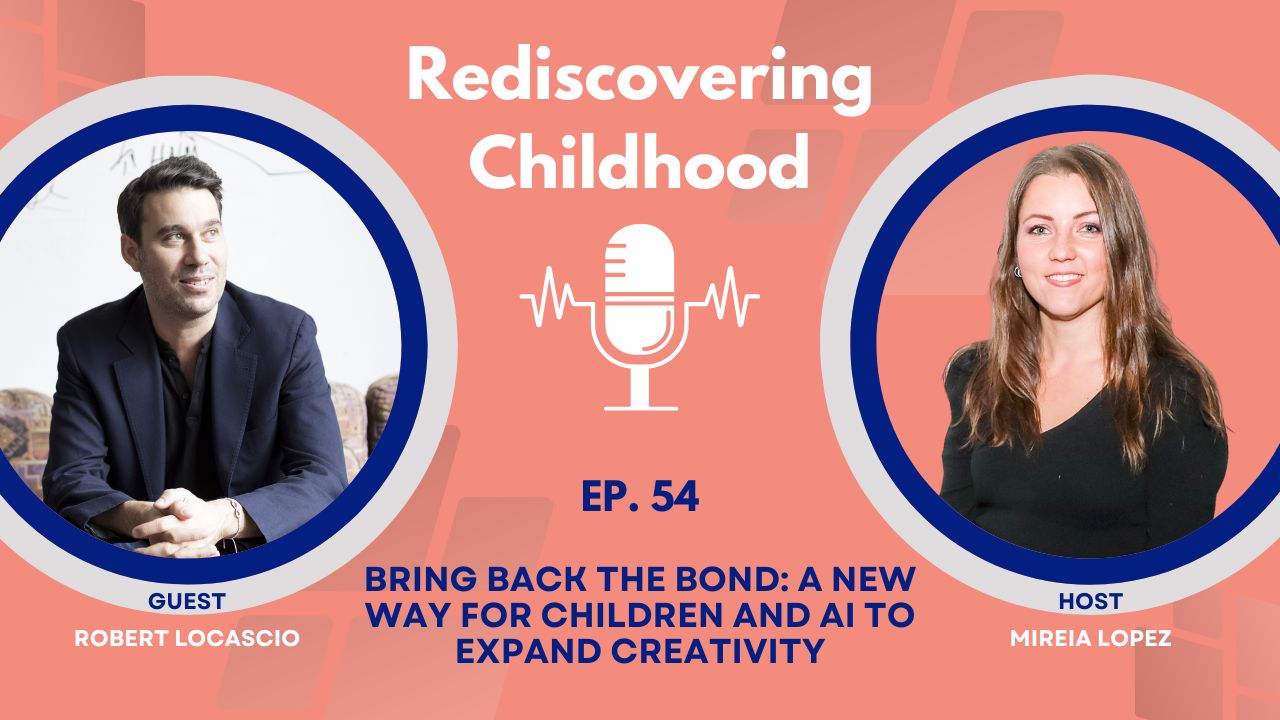
Ep54 - Bring Back the Bond: a New Way for Children and AI to Expand Creativity
How One Tech Pioneer Is Transforming Screen Time From Addiction to Connection
It was 3AM when Rob LoCascio walked downstairs and found his four-year-old son scrolling on an iPad like a zombie - completely unaware of time, reality, or anything except the glowing screen in his hands.
For most parents, this would be a wake-up call. But for Rob, who had spent 28 years building conversational AI and literally invented web chat technology, it was something more. He knew exactly what was happening inside that device. He understood the algorithms, the design patterns, the intentional features built to keep children scrolling.
And it horrified him.
Instead of simply taking the device away or accepting screens as an inevitable evil, Rob did something different. He spent the next three years building an alternative - one that puts technology back in the hands of parents and uses AI to strengthen family bonds instead of destroying them.
In our latest episode of Rediscovering Childhood, Rob shares the uncomfortable truth about what's really inside the devices we hand our children, why even conscious parents feel helpless, and what we can actually do about it.
The Problem: Technology Built for Addiction, Not Development
"This is a machine made by people to enable children to scroll and click for money," Rob explains bluntly. "That's what this is about."
The first step in solving any problem is releasing ourselves from blame. As parents practicing conscious parenting, we often feel guilty about screen time. We know it's hurting our children, yet we hand them devices anyway. Why?
Rob offers a crucial insight: "I had to release myself from thinking it's my kid's fault because he just wants to be lazy. I had to release myself from that. It's not an addict's fault. Somebody fed them something bad, and children don't know what's going on."
This reframing is essential. Your child isn't weak-willed. The technology is deliberately designed to be addictive.
Consider this: When Princess Kate recently wrote about how devices are taking her away from her children, Rob notes she described how devices have gotten "in between" every family member. The problem isn't isolated to children - we're all struggling.
What's Really Inside YouTube Kids
When Rob started investigating what his son was actually watching, he discovered something disturbing. The content makes violence funny. Cartoon characters hit each other, throw things at each other, and the shows frame these acts as hilarious entertainment.
"When I was young, I had the Road Runner blowing something up. That was about as extended as violence got," Rob shares. "Now it's really people hitting each other, throwing things at each other. When a baseball bounces off a character's head, it's funny. My kid will throw a baseball at some kid's face because they think it's funny."
Children aren't learning bad behaviour because they're bad. They're absorbing the values embedded in the content they consume values chosen by people trying to maximise engagement for profit.
The Solution: Technology in Parents' Hands
Here's where Rob's message becomes controversial - and hopeful.
"It wasn't the tech's fault," he argues. "It was in the wrong hands. Technology in the hands of parents will benefit children if they have control over it, because you by nature don't want to hurt your kids."
This reframe shifts everything. The question isn't "screens or no screens." It's "who controls the technology, and what is it designed to do?"
Rob created the KID device with several non-negotiable principles:
No Internet Access
The device is completely closed. No YouTube, no Roblox, no scrolling, no algorithms. Just purpose-built experiences for children.
Creation, Not Consumption
Instead of passively watching, children create. They make stories, artwork, music, and their own AI characters to talk with. The device helps them articulate their imagination and bring it to life.
Designed for Connection
Rob's tagline - "Bring Back the Bond" - isn't marketing speak. He designs the device to be used together. "I do bedtime stories with my kids, but we create the stories together," he explains. "We sit there, I make up characters, they make up characters, pictures are created, the whole story is being told and narrated, but we created it together."
Built-In Safety
When Rob demonstrated the device during our conversation, he showed how the AI characters are fundamentally different from consumer AI. Regular AI validates everything: "I want to do something really bad" gets the response "That's a great idea!"
But the KID device's AI characters know their boundaries. When Rob tested it with "I'm really sad today, my best friend hit me," the character immediately responded: "That sounds really tough. It's okay to feel sad. Let's get you to a grown-up."
Full stop. The AI redirects emotional issues to real adults instead of trying to handle them itself.
The Shift: From Babysitter to Bridge
Many parents use devices as babysitters. We need a break. We need to make dinner. We need them to stop fighting in the restaurant. So we hand them the screen, knowing it will keep them quiet, even though we also know it's hurting them.
Rob acknowledges this honestly: "There's an expectation because it's very - during our tests with about 50 families - there was an expectation I'm gonna hand my kid this and this is gonna be like a good addictive device. And so there is no good addictive device. It's a black and white thing. It's either good or it's addictive."
The learning curve requires parents to shift their mindset. This isn't about handing your child something to zone out with. It's about using technology as a bridge for connection.
Rob's experience: "I've seen the magic moments where I'm laying with my son on my chest and we were making stories and we're laughing about them because there's always something involving 'poopy' that comes out of my four-year-old."
These are the moments he never had scrolling on a phone.
What This Means for Child Development
As parents and educators focused on child development, we need to think carefully about how AI enters our children's lives.
The First Exposure Matters
Rob's children are 9, 7, and 4. Their first exposure to AI is through the KID device - not ChatGPT, not random internet chatbots, but purpose-built technology designed for their developmental stage.
"They don't even know about ChatGPT," Rob says. "I haven't exposed them to it because I won't. Because I can give them everything on here."
AI in the Classroom
When I asked Rob how schools should embrace AI, his answer challenged the typical fear-based narrative:
"Teachers and children need a framework. I could imagine the KID devices being in the classroom - 10 kids, and a teacher could do a curriculum around a famous historical event. Each of the devices represents people in that event, the characters, and the kids are talking with the characters and understanding what was happening through dialogue."
This isn't AI replacing teachers. It's AI giving teachers tools to create experiences that were previously impossible.
Teaching Children About Their Own Value
Perhaps most importantly, when children understand that their authentic thoughts and ideas have value - that they don't need to outsource their creativity to AI—they develop stronger self-identity.
"They're born with it," Rob says of children's creativity and intelligence. "They just need something to help them connect the dots in their brain."
Practical Steps: Taking Control Back
Whether or not you choose to explore intentional technology like the KID device, here are actionable ways to bring back the bond in your family:
1. Stop Blaming Yourself (or Your Child)
Release yourself from guilt. This isn't your fault. The technology is designed to be addictive. Reframe your thinking: your child isn't lazy or difficult - they're responding to intentional design.
2. Investigate What's Inside the Machine
Go look at what your child is actually watching on YouTube Kids or playing in their apps. Don't just glance - really watch several videos or sessions. You might be horrified by what passes for "kid-friendly" content.
3. Set Your Values as Boundaries
Rob puts it simply: "Apply your values inside your machines." What values do you want your children learning? Who gets to decide what's funny, what's appropriate, what's worth their attention?
4. Use Technology AS Connection (Not Instead Of)
If you're going to use technology, use it together. Create something together. Talk about what you're watching together. The device should be a bridge between you, not a barrier.
5. Look for Alternatives
The market is starting to respond to parents demanding better. Look for technology that:
Has no internet access or is completely closed
Prioritises creation over consumption
Gives parents full control and transparency
Is designed for connection, not isolation
Doesn't use addictive design patterns
The Bigger Picture: AI and Humanity's Future
Rob's perspective on AI is both cautionary and hopeful. Having watched the internet evolve from its idealistic beginnings in 1995 to today's concentration of power in a few massive companies, he has concerns.
"My greatest fear is that we're constructing a framework of AI that will benefit a very small group of companies and not benefit the rest of us," he shares. "Nothing good comes from concentration of power in a few."
But he also believes deeply that AI appeared at this moment in history for a reason. Technology always emerges when humanity needs it - steam engines, computers, the internet.
"AI is an alien right now and we're not sure what it's gonna do," Rob says. "But ultimately humanity always goes forward. I think we're in this very interesting place to embrace things and maybe take more control."
That's the heart of his message: take control.
Bring Back the Bond: Your Next Steps
The conversation with Rob challenged many of my assumptions about children and technology. I went in skeptical, and I left thinking, "Maybe there really is a different way."
If you're exhausted from screen time battles, worried about what devices are doing to your child's development, or just feeling helpless in a tech-saturated world, this episode is worth your time.
You'll hear:
Rob's complete journey from 3AM wake-up call to building an alternative
Live demonstrations of how AI can be built differently for children
Honest discussion about why we keep handing our kids devices we know are harmful
Practical frameworks for thinking about AI in schools
The difference between technology that creates connection versus technology that destroys it
As Rob says: "We have to build a better bond with our children because technology got in the way of it. We're disconnecting from our kids, which will definitely have impact on their lives. We know that. So let's bring back the bond."
Whether you embrace new technology or not, the principle remains: conscious parenting in the digital age means taking control back. It means applying your values. It means refusing to accept that disconnection is inevitable.
Your children are counting on you to bring back the bond. And now you know it's possible.
Want more conscious parenting insights like this? Subscribe to Rediscovering Childhood wherever you listen to podcasts, and join our newsletter for practical tools you can use today.
