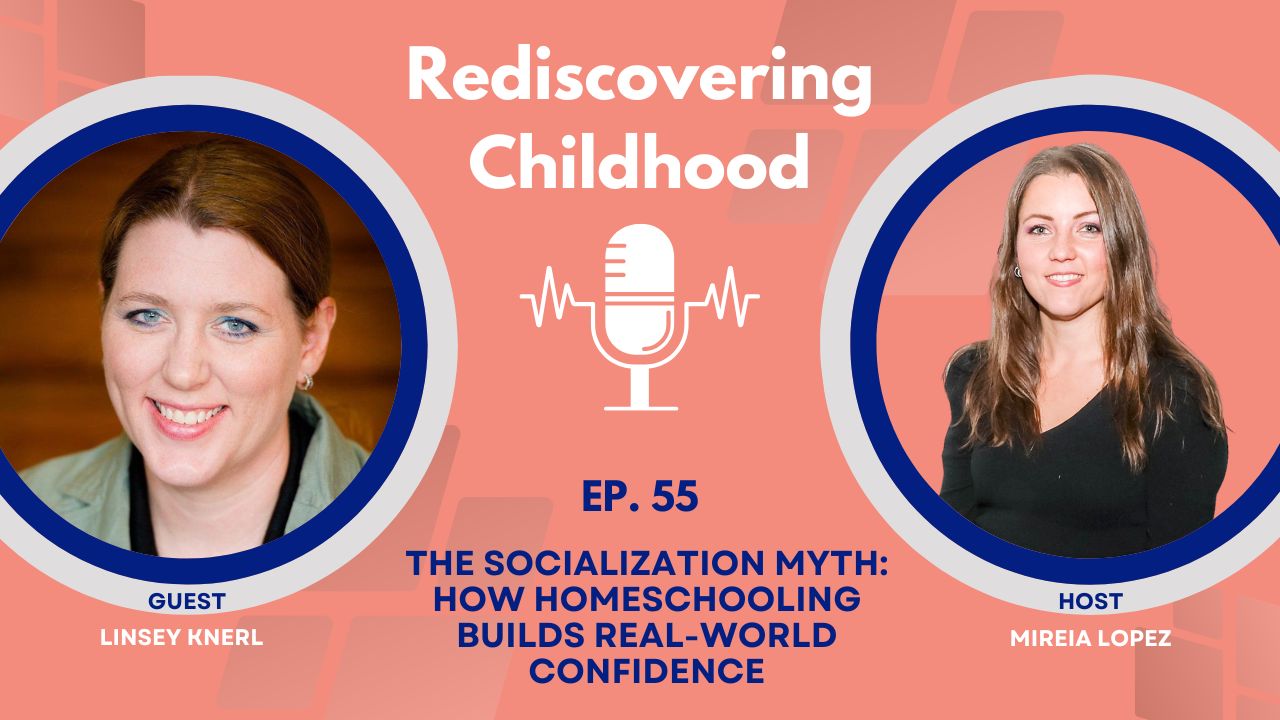
Ep55 The Socialisation Myth: How Homeschooling Builds Real-World Confidence
Homeschooling While Working Full-Time: Linsey Knerl's Proven Framework
Can you really homeschool your children while maintaining a full-time career? According to Linsey Knerl, author of Homeschool Hacks and working mother of six, it’s not only is it possible, it's one of the most rewarding decisions her family has made. In the latest episode of Rediscovering Childhood, Linsey shares nearly two decades of hard-won wisdom about balancing homeschooling with professional work, fostering genuine autonomy in children, and creating meaningful connections that last well into adulthood.
In the latest episode of Rediscovering Childhood, Linsey shares nearly two decades of hard-won wisdom about balancing homeschooling with professional work, fostering genuine autonomy in children, and creating meaningful connections that last well into adulthood.
The Myth That Stops Parents Before They Start
Most parents assume homeschooling requires one parent to become a full-time teacher, abandoning their career and somehow mastering every subject from kindergarten through high school. Linsey's experience proves otherwise.
"You're not trying to be your child's teacher for everything," Linsey explains. "You're a curator of their educational opportunities."
This reframe changes everything. Instead of needing expertise in calculus, chemistry, and classical literature, parents become skilled at connecting their children with passionate instructors, quality online programs, community co-ops, and resources that match each child's learning style and interests.
How Homeschooling Actually Builds Social Confidence
The socialization question is typically the first objection parents raise. Won't homeschooled children be awkward? Won't they miss out on critical social development?
Linsey's response challenges this assumption entirely:
"My children interact with people of all ages; babies, elderly neighbours, adults, teenagers, and younger children. They're not segregated by age like in traditional schools."
The benefits of mixed-age socialisation include:
Greater comfort communicating with adults and authority figures
Natural mentorship opportunities with younger children
Exposure to diverse perspectives across generations
Reduced peer pressure and social hierarchy stress
Linsey shares that her homeschooled children naturally advocate for themselves in college, utilize professor office hours without intimidation, and move fluidly between different social groups; skills that serve them far beyond their school years.
One powerful example: when her younger son first attended a camp with public school children, he was confused why they raised their hands to use the restroom. At home, he simply went when he needed and returned to his work. This autonomy, trusting himself to make basic decisions, is something that develops naturally in a homeschool environment but can be difficult to cultivate in large classroom settings.
The Truth About Homeschool Problems
One of Linsey's most powerful insights:
"Almost all homeschool problems are parenting problems. It's not the curriculum, it's not the book; it's usually a communication issue or relationship challenge."
Rather than being discouraging, this realization is actually liberating. Curriculum can't fix relationship dynamics, but relationship work creates the foundation for all learning. When parents focus on communication, boundaries, and genuine connection, the educational pieces fall into place more naturally.
This aligns with conscious parenting principles: our children's learning happens within the context of relationship. When we strengthen that foundation, everything else improves.
Common signs you're facing a parenting challenge, not a curriculum problem:
Your child resists sitting down to do work
You feel constant frustration during learning time
There's tension around educational activities
You're overwhelmed and feel like you're failing at everything
Linsey recommends asking yourself:
"What specifically am I struggling with?"
Often, it's not actually the homeschooling; it's grief, relationship stress, boundary issues, or communication breakdowns that need addressing first.
Budget-Friendly Homeschooling Strategies
Concerned about cost? Linsey offers practical solutions that have worked for her family:
Free and low-cost resources:
Public libraries - Books, programs, and sometimes homeschool materials to borrow (most people read Linsey's own book by checking it out from the library!)
YouTube tutorials - For specific skills and subjects when you're stuck
AI tools like ChatGPT or Claude - For explaining complex concepts in accessible ways ("Explain the Pythagorean theorem using basketball metaphors for a 12-year-old")
Community co-ops - Parents share teaching responsibilities
Online programs - Many offer sibling discounts or multi-child rates
"Information is so widely available now," Linsey notes. "If you can find quality, authoritative sources, you don't have to spend a lot of money."
What Are Homeschool Co-ops?
Co-ops have exploded in popularity since the pandemic. Parents gather weekly for 3-hour sessions where children take classes together. One parent might teach ceramics, another leads a science lab, another facilitates a book discussion.
This model allows:
Shared resources (expensive lab equipment, art supplies)
Social interaction for children
Community support for parents
Affordable enrichment activities
Expertise sharing without hiring tutors
Raising Autonomous Learners
Perhaps the most compelling benefit Linsey describes is the autonomy homeschooled children develop. Without constant instruction on when to move, speak, or even use the restroom, children learn to trust their own judgment and take responsibility for their choices.
This autonomy translates directly into adult success. Linsey's college-aged children:
Proactively seek help from professors when needed
Take advantage of tutoring and extra study sessions without being prompted
Understand that their education is their responsibility
Advocate effectively for accommodations when necessary
One of Linsey's sons has dyslexia, dysgraphia, and dyscalculia, diagnosed late at age 18. The flexibility of homeschooling allowed them to take a gap year to understand his needs and find the right accommodations, rather than being pressured to follow a traditional timeline. He's now thriving in college, confident in his ability to navigate challenges.
"The best gift you can give your children is to watch you fail and get back up and do it again," Linsey shares. This modelling of resilience matters more than perfection.
Fuelling Learning Through Curiosity
Linsey uses her children's passions as fuel for difficult tasks. Her 12-year-old son is obsessed with cats and talks about them constantly, drawing them everywhere.
Rather than seeing this as a distraction, Linsey leverages it:
"Finish the even-numbered math problems, then draw cats at the bottom of your worksheet.”
His first public speech? "The Five Best Breeds of Cats", something he's genuinely excited to share
Reading comprehension? Books about cats and animals
This approach works because it honours the child as their own person, not an extension of parental dreams or unmet needs. "They're their own person”, Linsey emphasises. "Homeschooling gives you time to really know them and respect that."
When to Consider Homeschooling
Linsey emphasises that safety comes first. If a child is experiencing bullying, struggling with mental health in a school environment, or facing other immediate concerns, parents have permission to remove them immediately and figure out the educational details afterward.
Signs homeschooling might benefit your family:
Your child's curiosity is being stifled by rigid schedules
You want more flexibility to pursue interests deeply when they emerge
Your child has learning differences not being adequately addressed
You value family connection and want more time together
You're drawn to alternative educational philosophies
Your child is experiencing social or emotional challenges at school
Starting Your Homeschool Journey
If you're considering homeschooling, Linsey recommends starting small:
1. Research your local laws and requirements for homeschooling compliance
2. Prioritise safety - If your child is in danger (bullying, mental health crisis), remove them immediately. Don't wait to have the "perfect" curriculum.
3. Define your values - What do you want to be at the core? Books and reading? Social interaction? Hands-on learning? Build around that.
4. Don't buy an expensive curriculum yet - Borrow from friends, try library resources, use free trials. See what actually works for your family before investing.
5. Start with one favourite subject - Build positive associations with home learning before adding more.
6. Allow transition time - Children coming from traditional school may need weeks to decompress and figure out who they are without constant external structure.
7. Find your people - Connect with other homeschooling families, but remember that they don't know your unique situation. Trust yourself over internet advice.
Remember: you don't need to have everything figured out on day one. Homeschooling is a process where you'll learn and adapt alongside your children.
The Time Reality: Quality Over Quantity One of Linsey's most reassuring points: homeschooling doesn't require 8-hour school days.
"You can get things done in two to three hours versus eight, because there's not all that back and forth between classes and moving around and waiting for Jimmy in the corner to be quiet so we can start our math test," she explains.
The time is concentrated and quality-focused. There's no:
Waiting in lines
Waiting for the bell to ring
Waiting for the teacher to call on you
Transitions between classes
Managing 30+ children's needs simultaneously
This efficiency is what makes homeschooling possible for working parents.
Combining Entrepreneurship and Homeschooling
As a business owner herself, Linsey has found that homeschooling and entrepreneurship can complement each other beautifully. Her children have gained real-world skills by helping with the family business:
Organizing inventory
Sending invoices
Understanding business cycles
Taking ownership of outcomes
"When we win as a business together, the kids really feel like they've won as well," Linsey shares.
The pandemic shifted workplace culture; now, having children visible during Zoom calls is normalised rather than hidden. This cultural shift has opened doors for working parents to integrate family and career more authentically.
The Ripple Effect of Educational Autonomy
At its core, Linsey's homeschooling philosophy aligns beautifully with the mission of Rediscovering Childhood: creating meaningful connections that ripple outward into families and communities.
When children learn to trust themselves, advocate for their needs, and pursue their genuine interests, they become adults who contribute thoughtfully to the world around them. They understand that learning is lifelong, that failure is part of growth, and that their education belongs to them.
They don't identify primarily by age or school affiliation. Instead, they form connections based on shared interests, values, and activities. This creates more authentic, lasting relationships.
For Parents Currently Homeschooling and Feeling Overwhelmed
If you're already homeschooling but struggling, Linsey offers this framework:
Ask yourself: "What specifically am I struggling with?"
Often, overwhelmed parents say "everything" because the emotional weight feels universal. But when you dig deeper, it's usually one or two specific issues:
Grief over a loss
Relationship tension with spouse
Child won't focus on math
Feeling isolated
Burned out from lack of self-care
Identify the real problem. Then address that, not by changing curriculum, but by getting support for the actual challenge.
Two key reminders from Linsey:
Find your people - There are homeschooling families who share your values and perspective. Connect in real life, not just online. Use online groups to find local connections, then build real relationships.
You have more time than you think - Your concentrated learning time is powerful. Don't panic that you're "behind" some arbitrary standard. Your quality time matters more than hours logged.
The Question for Your Younger Self
At the end of our conversation, I asked Linsey what she wishes someone had asked her younger self. Her response was beautiful:
"I used to think I had to have everything perfect before I could be a good mom, a clean house, a nice house, all my emotional problems solved, family relationships healed. But that's not true. If we waited for that, we'd be 102 and we'd never have children."
Her advice: Start when you're ready. And you're ready when you're considering it.
The best gift you give your children isn't perfection; it's watching you fail, get back up, and try again. That's the model they need for their own lives.
Ready to explore homeschooling further? Listen to the complete conversation with Linsey Knerl on the Rediscovering Childhood podcast. Whether you're seriously considering homeschooling or simply want fresh perspectives on supporting your child's learning at home, this episode offers practical wisdom you can apply immediately.
Subscribe to Rediscovering Childhood on Spotify, Apple Podcasts, or watch on YouTube.
